.svg)


In the fast-paced USA inbound call center environment, how calls are transferred can make or break the customer experience. Daily, thousands of customer interactions involve transferring calls between departments or specialists. However, not all call transfers are created equal. Understanding the difference between warm and cold transfers — and knowing when to use each — can dramatically impact customer satisfaction, resolution times, and your business's reputation.
Think about it from your experience: Have you ever had to repeat your entire story to multiple agents after being transferred? Or have you experienced a smooth handoff, where the new agent already knew your situation? These represent the two approaches to call transfers in modern customer service.
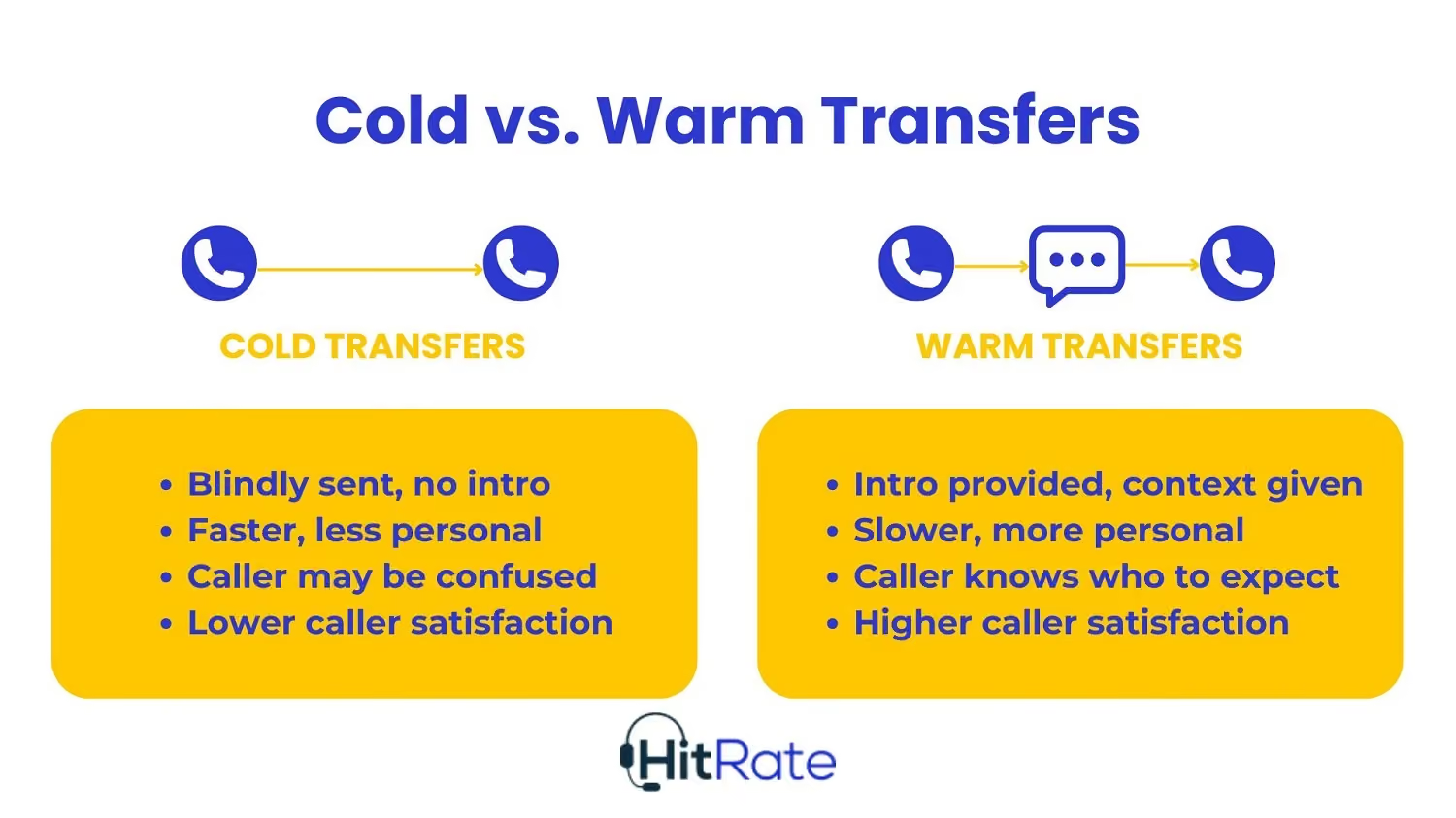
What Is a Cold Transfer in a Call Center?
A cold transfer (sometimes called a blind transfer) occurs when a call center agent connects a customer to another department or specialist without providing background information about the customer's query or issue. As a result, the receiving agent has virtually no context about why the customer is calling, forcing the customer to explain their situation all over again. As a customer, this is incredibly frustrating.
Cold transfers are often quick for the initial agent but can lead to customer dissatisfaction and longer overall resolution times.
Format of a Cold Transfer
Here's how a typical cold transfer plays out:
Customer Support Agent: "Thank you for calling [Your Company]. This is Marcus speaking."
Customer: "Hi, Marcus. I ordered your premium service package last week, but I'm still waiting for account activation. It's been five business days now."
Customer Support Agent: "I understand your concern. Could you provide your order number and email address?"
Customer: "Order #BRT-29354, email is [email protected]."
Customer Support Agent: "Thank you for that information. This is an activation issue that our technical team needs to handle. I'll transfer you now."
(Customer hears hold music for 30 seconds)
Technical Support: "Technical support, this is Lisa. How can I help you today?"
Customer: (clearly annoyed) "I've been waiting five days for my premium account activation. I just gave all my information to the previous agent, and now I need to start over again?"
Technical Support: "I apologize for the inconvenience. Can you please provide your order number so I can look into this for you?"
The cold transfer created a frustrating experience where the customer felt their time wasn't valued and had to repeat information they'd already provided.
Advantages & Disadvantages of Cold Transfers
Pros:
- Faster handling time for the initial agent
- Simple process requiring minimal training
- Allows agents to move quickly to the next customer
- Works well for high-volume, straightforward inquiries
Cons:
- Forces customers to repeat information
- Creates a disjointed customer experience
- Increases overall call duration
- May result in lost information
- Can lead to lower customer satisfaction scores
- Higher risk of customers abandoning calls
What Is a Warm Transfer in a Call Center?
A warm transfer (also known as an attended transfer) occurs when the initial agent first speaks with the receiving agent, explaining the customer's situation and providing relevant background information before connecting the customer. As a result, the customer doesn’t need to repeat themselves, creating a seamless and more enjoyable experience.
Warm transfers prioritize customer experience over agent convenience, demonstrating respect for the customer's time and patience.
Format of a Warm Transfer
Let's see how the same scenario would play out as a warm transfer:
Customer Support Agent: "Thanks for calling [Your Company], you're speaking with Anita."
Customer: "Hi, Anita. I'm calling because my company just upgraded to your enterprise plan, but we're having trouble setting up the custom reporting feature. Our marketing team needs these reports by tomorrow."
Customer Support Agent: "I understand the urgency, especially with your deadline approaching. May I have your company name and account ID?"
Customer: "Brightspark Innovations, account ID #BR-58721."
Customer Support Agent: "Thank you. The custom reporting feature requires specialized configuration. Let me connect you with Derek from our Enterprise Solutions team, who specializes in reporting. I'll briefly explain your situation to him first, so please hold for a moment."
(Brief hold for 20 seconds)
Enterprise Specialist: "Hello, we appreciate your patience. This is Derek from Enterprise Solutions. Anita tells me Brightspark Innovations needs urgent help with custom reporting configuration. I've already pulled up your account, and I can see you're on our new enterprise platform. Let's set up those reports right away, so your marketing team has what they need for tomorrow."
Customer: "That's fantastic! Thanks."
This warm transfer created a seamless experience where the customer felt their needs were understood and prioritized, with no time wasted repeating information.
Advantages & Disadvantages of Warm Transfers
Pros:
- Enhances customer experience
- Eliminates the need for customers to repeat information
- Provides complete context to the receiving agent
- Increases first-call resolution rates
- Builds customer trust and loyalty
- Creates professional impressions of your business
- Reduces overall handle time for complex issues
Cons:
- Takes more time for the initial agent
- Requires both agents to be available simultaneously
- May increase hold times during busy periods
- Requires more comprehensive agent training
- Can be resource-intensive for call centers
What’s the Difference Between a Cold and Warm Transfer?

We’ve explored two examples, but let’s delve into more details. Understanding the key differences between these transfer types can help you determine which approach best suits various scenarios in your call center operations.
1. Information Gap
Cold transfers create information silos. The first agent sends customers to another department with no context, forcing customers to become their information carriers across departmental boundaries.
Warm transfers bridge these gaps through agent-to-agent communication. The initial representative briefs the specialist on the customer's situation before bringing them into the conversation, maintaining continuity throughout the interaction.
In real-world terms, cold transfers are like pointing someone toward a stranger across a room. Warm transfers involve walking them over, providing an introduction, and ensuring they're connected properly. As you can imagine, warm transfers are much more enjoyable for the customer.
2. Trust Factor
Cold transfers damage relationship-building opportunities. When customers bounce between departments without proper handoffs, their experience feels fragmented. Each transfer forces them to restart, creating the impression that they're just another ticket number.
Conversely, warm transfers build connections. Personal introductions between the customer and the next representative demonstrate thoughtfulness and care. This approach recognizes the customer as an individual worth the extra effort.
The benefits include:
- Showcasing team cohesion rather than departmental isolation
- Respecting customers' time by preserving their previously shared information
- Demonstrating organizational competence through smooth handoffs
- Building trust through transparent communication
3. Emotional Journey
The experiential gap between transfer methods significantly impacts customer perception. Cold transfers create friction points where customers must repeat information, triggering frustration that can escalate into:
- Increased agitation and decreased patience
- Doubts about company competence
- Hesitation to engage with support in the future
- Lower satisfaction scores
- Potential recovery costs to repair the relationship
As you can see, warm transfers are the best for problem-solving. Organizations of any size can implement this approach with basic phone systems. The receiving agent advances the conversation immediately rather than retracing old ground. The result is an impression of efficiency and customer respect.
Cold Transfer vs. Warm Transfer: Which Should You Choose?

The right approach depends on your business priorities, call volume, and the nature of customer inquiries. However, warm transfers should be your default approach whenever possible, especially for:
- Complex customer issues requiring specialized knowledge
- Situations involving sensitive personal or financial information
- Cases where customers are already frustrated or emotional
- High-value clients or accounts
- Issues that have required multiple previous contacts
Cold transfers might be appropriate in limited circumstances, including:
- When a customer requests a particular agent or department
- For extremely simple redirections where minimal context is needed
- During periods of extremely high call volume, when agent availability is limited
- When customers have reached the wrong department entirely
The good news is that you don’t have to choose just one approach. Consider creating a decision tree for your agents to help them determine which transfer type is appropriate for different scenarios. This can include factors like:
- Customer's emotional state
- Complexity of the issue
- Availability of receiving agents
- Customer preference
- Issue sensitivity
- Call volume and wait times
The key is balancing operational efficiency with customer experience. While cold transfers may save a few seconds per call, warm transfers often result in faster overall resolution, higher customer satisfaction, and increased loyalty. Consider these factors and potential outcomes when determining which is best for your business.
How Can You Calculate Your Call Transfer Rate?
Data can also be a helpful factor in your decision. Tracking the call transfer rate provides insight into how often calls are moved between different parts of the call center’s system. This measurement lets you see the effectiveness of call handling. To calculate it, use the following formula:
Transfer Rate (%) = Total Number of Calls / Number of Transferred Calls x 100
Here's an example:
- In one day, you receive 800 total calls.
- Out of those 800 calls, 64 calls must be transferred to a specialized tier-2 support team.
Now, let's calculate the call transfer rate:
- Transfer Rate (%) = 80064 x 100
- Transfer Rate (%) = 0.08 x 100
- Transfer Rate (%) = 8%
Enhance Your Customer Experience with Professional Call Center Services

The difference between cold and warm transfers illustrates a broader principle: small details in customer service delivery can impact customer perception. The right call transfer protocols in your business can boost your customer experience while improving operational efficiency.
Hit Rate Solutions is a USA call center that prioritizes warm transfers whenever possible. Our professionally trained agents understand when and how to use each transfer type to maximize customer satisfaction.
With our virtual receptionist services, phone answering capabilities, and comprehensive agent training, we ensure your customers always receive the seamless, professional experience they deserve. If you’re looking for a reliable call center that cares about your customers as much as you do, you’re in the right place.
Ready to elevate your customer experience? Contact Hit Rate Solutions today!