.svg)


Call Center Services Pricing: A 2026 Cost Breakdown
Call center services pricing varies widely, and many businesses end up overpaying simply because they compare the wrong numbers. Rates depend on factors such as geography, service type, and agent specialization. This guide breaks down the real cost of call center services in 2026, including pricing models, regional benchmarks, hidden fees, and what to look for when comparing providers.
Types of Call Centers and Their Pricing Models
The type of center you partner with directly shapes the pricing structure you'll work under. Here's how the main categories break down.

Inbound Call Centers
Handle incoming customer calls such as support inquiries, complaints, and account questions. Pricing usually follows hourly or per-minute billing.

Outbound Call Centers
Contact prospects directly for lead generation, appointment setting, surveys, and sales outreach. Pricing commonly uses hourly, per-lead, or per-appointment models.

Blended Call Centers
Combine inbound support and outbound outreach, allowing agents to switch between customer service and prospecting depending on call demand.

Omnichannel Contact Centers
Support customers across multiple channels including phone, email, live chat, and social media. Because several platforms are involved, pricing is typically higher than voice-only services.
Key Factors That Affect Call Center Services Pricing
The hourly rate you see in a proposal is shaped by several variables. Understanding them helps you anticipate costs before comparing quotes.

Service Type
Inbound support costs less than outbound. Cold calling, lead generation, and appointment setting require stronger agent skills, which is reflected in higher rates.

Call Volume
Higher monthly volumes unlock better pricing. Most providers offer tiered rates, so estimating your volume accurately before reaching out saves time on both sides.
.svg)
Level of Specialization
Programs requiring HIPAA compliance, technical troubleshooting, or industry-specific knowledge carry a premium over standard service rates. The more specialized the role, the higher the staffing and training costs.
.svg)
Dedicated vs. Shared Agents
Shared agents cost less per hour. Dedicated agents deliver better consistency and faster handle times over time. For programs where quality matters more than cost minimization, dedicated is usually worth the difference.
.svg)
Contract Length
Month-to-month arrangements carry higher per-unit rates than annual contracts. Committing to a longer program typically reduces your rate and gives the provider room to invest more in training for your account.
.svg)
Technology Requirements
CRM integrations, custom reporting, or multilingual IVR aren't always included in the base rate. The more complex your tech requirements, the more likely you'll see platform fees on top of agent costs.
What Call Center Services Actually Cost in 2026
The growth of cloud platforms, automation tools, and performance-based contracts has expanded the range of pricing structures available to businesses. As a result, comparing providers now requires looking beyond the headline rate to understand what is actually included.
The True Cost of Running an In-House Call Center
For a 10-agent in-house operation, total annual costs typically land between $500,000 and $650,000:
Cost Component
Per Agent (Annual)
10-Agent Team (Annual)
Base Salary (Entry Level)
$35,000–$40,000
$350,000–$400,000
Benefits & Taxes (+20%)
$7,000–$8,000
$70,000–$80,000
Recruitment & Training
$2,500–$4,000
$25,000–$40,000
CCaaS Software
$75–$159/agent/month
$9,000–$19,000
Security & Compliance Tools
~$60/user/month
~$7,200
Office Space and Utilities
Included
Separate Expense
Hardware & Networking
$2,000 upfront + ongoing
$5,000–$10,000
Estimated Total
$500,000–$650,000
The Cost You're Probably Not Counting: Attrition
Call center turnover runs 40–45% annually. Replacing one agent costs $2,500 in screening alone, $1,500–$2,000 in training, and over $30,000 total when lost productivity is included. With the average tenure at just 14.3 months, that cost recurs constantly and disappears entirely when you outsource.
Call Center Pricing by Region: 2026 Benchmarks
Location is the single biggest cost lever. Current rates for standard and specialized support:
Region
Standard Rate (USD/hour)
United States/Canada
$25–$45
Western Europe
$25–$40
Eastern Europe
$12–$25
Latin America (Nearshore)
$12–$20
Philippines / Asia
$6–$15
India
$6–$12
Onshore US pricing continues to rise as state-level minimum wages increase. Cities like Washington D.C., New York, and California now operate with hourly labor floors well above the federal minimum. Even so, offshore locations remain several times more cost-effective for most outbound and customer support programs.
Common Call Center Pricing Models
Different providers structure pricing in different ways. Most call center programs fall into one of the following models.
Hourly Pricing
This is the most common structure for ongoing inbound and outbound programs. Businesses pay for agent time regardless of call outcomes. The model is predictable and easy to forecast, and is convenient for consistent call volumes, ongoing customer support, and phone answering.
Performance-Based Pricing
Pricing is tied to outcomes such as leads generated, appointments booked, or sales closed. This model is frequently used in outbound lead generation campaigns.
Dedicated Agent Pricing
Companies pay a monthly fee for agents working exclusively on their account. Offshore dedicated agents typically range from $1,200 to $3,500 per month depending on experience and specialization.
Pay-Per-Resolution
In this structure, businesses pay only when a customer issue is fully resolved. It is becoming more common in AI-assisted support environments.
Each model works best under different conditions, depending on call volume, service complexity, and how results are measured.
Outsourcing vs. In-House: The Full Cost Comparison
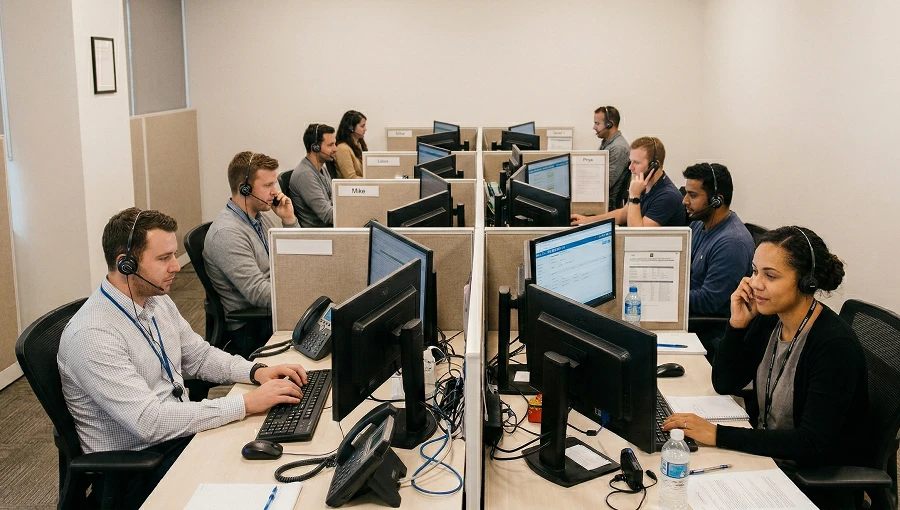
The financial case for outsourcing is strong at any business size. Here's the side-by-side breakdown of what each approach actually costs:
The financial case for outsourcing is strong at nearly any business size. Compared with building an in-house call center, outsourcing shifts many operational costs to the provider and reduces the need for internal infrastructure.
Key differences typically include:
Setup costs: Outsourced call center programs usually require minimal setup, while in-house operations involve significant upfront investment in hiring, training, and infrastructure.
Staffing and recruitment: Outsourcing providers handle recruitment, salaries, and management. In-house teams must manage hiring, payroll, and HR internally.
Technology and software: Dialers, reporting platforms, and call center software are typically included in outsourced programs, while in-house teams must purchase and maintain these systems.
Office space and equipment: Outsourcing providers cover workspace, utilities, and hardware. Internal teams must budget separately for office infrastructure.
Scalability: Outsourced teams can scale quickly as call volumes change. In-house operations are constrained by hiring timelines and fixed infrastructure.
24/7 availability: Many outsourcing providers offer round-the-clock coverage as part of their service, while in-house teams usually require additional staffing or overtime to match the same availability.
Scaling highlights the cost difference. Expanding an in-house team requires new hires, workspace, and software, while outsourced programs scale quickly using existing infrastructure.
Outsourcing typically reduces operational costs by 40% to 70% compared to an equivalent in-house team, freeing budget for revenue-generating activities instead of operational overhead.
Outsource Your Call Center and Cut Costs by Up to 70%
Hit Rate Solutions provides trained, dedicated agents for inbound and outbound programs. Transparent pricing, no hidden fees.
Industry-Specific Call Center Pricing
Standard rates provide a baseline, but compliance requirements, specialized training, and industry complexity all push costs higher in certain sectors.
Healthcare and Insurance
Healthcare programs require HIPAA and SOC 2 compliance, adding a 12–18% premium over standard rates. Revenue Cycle Management and specialized intake push onshore rates toward $40–$50/hour. For insurance call center programs, agent specialization and first-call resolution are the primary cost drivers.
Real Estate
Real estate requires fast lead response and strong objection-handling skills. Standard outbound rates apply, with modest premiums for bilingual agents or extended hours. A single closed transaction from a real estate cold calling campaign can offset months of service costs.
Technical Support and IT
Technical support is priced by tier:
Standard tech support/tier 1: $20.69–$29.57/hour
Help desk technician: $20.52–$27.08/hour
IT help desk manager (in-house equivalent): ~$93,226/year
Outbound technical outreach typically carries a 30% premium over inbound due to the initiative and troubleshooting depth required. Average handle time for technical calls also exceeds the industry standard, which increases cost-per-contact for this service type. See how we support IT call center programs across the technology sector.
AI and Automation: How It's Changing Call Center Costs

AI tools are absorbing high-volume, low-complexity contacts: basic FAQs, account checks, simple troubleshooting, at a fraction of human agent cost. The bigger impact for most businesses today is AI as an agent-assist layer: shortening handle times and improving resolution rates without replacing staff.
The most cost-effective setup for most businesses is hybrid: AI on routine contacts, human agents on complex ones, and agent-assist tools reducing handle time across the board.
Hidden Costs in Call Center Contracts
When evaluating outsourcing providers, the base hourly rate is rarely the total cost. Many businesses receive an initial quote that looks reasonable, then encounter a range of additional charges once the contract is in place. Here are the most common additions to watch for:
Technology integration fees: Typically 5–10% of contract value.
Agent ramp-up costs: First-year costs often run 15–20% higher.
QA program fees: Typically adds 5–8% to total spend.
Compliance premiums: HIPAA/SOC 2 regulated sectors add 12–18%.
Setup/onboarding fees: One-off costs from a few hundred to several thousand dollars.
Platform costs: Some providers charge separately for call center software.
Reputable providers are upfront about all of these before you sign anything. Always ask for a fully loaded monthly estimate rather than just the hourly rate, and compare providers on total cost rather than the number that appears first in their pitch.
Key Performance Metrics That Affect Your Actual Cost
The cost of call center services isn't just about what you pay per hour — it's about how efficiently those hours are used.
Several operational metrics influence the real cost of call center services:
Average Handle Time (AHT): Longer calls increase cost per contact.
First Call Resolution (FCR): Higher resolution rates reduce repeat contacts.
Occupancy rate: Low occupancy indicates overstaffing.
Call abandonment rate: High abandonment means lost opportunities and wasted staffing capacity.
A program at 80% FCR generates far fewer total contacts than one at 60%. Every repeat call is a cost that didn't need to exist.
How to Estimate Your Call Center Budget

Getting an accurate cost estimate before reaching out to providers saves time and prevents surprises. Work through these steps to build a realistic baseline:
- Define your service type: Inbound, outbound, or blended. Each has different pricing implications.
- Estimate call volume: Daily, weekly, monthly. Higher volumes unlock better rates.
- Consider location: For most US businesses, Philippines-based agents offer the best quality-to-cost ratio.
- Identify specialization needs: Compliance, technical expertise, or industry terminology all carry a premium.
- Pick a pricing model: Match hourly, per-lead, or dedicated agent to your volume consistency and measurement capability.
- Request itemized quotes: Compare total cost of ownership, not just the headline rate.
Once you have estimates from two or three providers, the comparison becomes straightforward. Look at what's included, what's billed separately, and whether the pricing model actually fits how your call volume behaves month to month.
Strategies to Reduce Call Center Costs
Affordable call center services exist — but "affordable" doesn't mean the cheapest rate on the market. It means the right combination of price, quality, and fit for your specific program. Here's what to actually evaluate:
Improve First-Call Resolution
Every repeat call is a cost that could have been avoided. Investing in agent training and knowledge bases drives FCR toward the 80% benchmark and directly reduces total call volume.
Use Self-Service for Routine Contacts
IVR and AI chat handle basic contacts at a fraction of agent cost. Routing FAQs and account inquiries to self-service reduces staffed hours without degrading customer experience.
Align Staffing to Volume Patterns
Workforce management tools optimize staffing based on call volume, wait time targets, and planned shrinkage. Overstaffing is one of the most consistent sources of wasted spend.
Explore Hybrid Pricing
For outbound programs, a pay-per-meeting model typically running $175–$350 per qualified meeting is often more cost effective than hourly billing for cold calling campaigns.
Why Hit Rate Solutions
Hit Rate Solutions is a Philippines-based outsourcing company serving US and Canadian businesses across insurance, real estate, healthcare, retail, IT, manufacturing, and small business, with both inbound and outbound programs and transparent, no-surprise pricing.
What sets us apart:
Competitive offshore pricing with US-based management from our Elk Grove Village, Illinois office.
Dedicated agents who build real product knowledge, not shared pools rotating between accounts.
Flexible pricing models: hourly or hybrid.
Industry-trained agents for regulated sectors including insurance, healthcare, and real estate.
Full inbound and outbound coverage: customer support, phone answering, order taking, virtual assistance, lead generation, cold calling.
Built-in quality assurance: call monitoring and performance reporting included.
Scalable programs that adjust to your call volumes without long-term staffing commitments.
We offer the best value: agents who know your business, pricing that's predictable, and results you can track.
Affordable Call Center Services, Starting Today
From customer support to lead generation, we build programs around your call volumes and budget. No long-term commitments required.

.svg)
Get a Quote
for Your Call
Center Program
The right price depends on your call volume, service type, and program complexity. Talk through your specifics with our team and we'll put together a clear, itemized estimate.

.svg)