We work 24/7 in the USA, Australia, and Canada

HitRate logo

(855)-641-0585

Phone icon

by Mary Salgado

Updated:

Apr 16, 2026

What Does an Appointment Setting Service Cost? 2026 US Pricing Guide.

Table of Contents

    Outsourced Healthcare Call Center: Success Stories

    Before we go into detail, let's look at some real-life examples. These stories show how providers used outsourced healthcare call center services to enter new markets.

    ‍

    Background curve

    Mitchell Kahl, Sales Manager, SIP.US

    In my role at SIP.US, I've seen the transformative power of SIP trunking for healthcare providers navigating new markets. A notable example involves a group of medical clinics that leveraged our virtual call center capabilities. By integrating SIP trunking, they reduced communication costs by 50% and improved patient call handling efficiencies, leading to a 30% boost in patient inquiries from new regions.

    In another instance, adopting SIP technology enabled a healthcare provider to seamlessly enter rural markets without establishing physical locations. The ability to route calls efficiently and provide remote consultations increased patient reach by 40%. This flexibility in communication

    Vincent Cerniglia, Principal, Noreast Capital Corporation

    In my experience with Noreast Capital, leveraging flexible financial solutions, including outsourced call centers, has been instrumental in helping various sectors, like healthcare, effectively enter and expand new markets. We worked with a healthcare provider that increased their patient outreach by 35% within six months thanks to strategic equipment leasing, which also involved utilizing outsourced call center operations to handle patient inquiries efficiently.

    For example, a client in the medical imaging sector used call centers to schedule appointments, answer inquiries, and manage follow-ups. This not only improved customer service satisfaction rates but allowed the healthcare provider to focus on expanding services without putting extra strain on their staff. Outsourced call centers enabled them to penetrate new regions with a 20% increase in patient bookings, clearly showcasing how such integrations can facilitate market expansion.

    David Pumphrey, CEO, Riveraxe LLC

    At Riveraxe LLC, we've seen how outsourced call centers can significantly boost healthcare providers by expanding their market reach. For one of our clients, a mid-sized healthcare practice, we deployed an outsourced call center that specialized in multilingual support. This allowed them to enter non-English-speaking regions effectively, increasing patient engagement by 30% in just six months.

    The call center also offered 24/7 support, which was pivotal for handling international time zones and after-hours inquiries. This capability enabled our client to tap into international markets, conrributing to a 15% revenue increase in the first year. By leveraging outsourced call centers, healthcare providers can break geographical barriers, accessing a wider patient base and improving service accessibility worldwide

    Corin Dolan, Owner, AccuTech Communications

    At AccuTech Communications, we have worked with healthcare providers to improve their communication infrastructure, indirectly aiding market expansion. For example, we partnered with a regional healthcare provider to upgrade their entire network cabling system, which significantly improved their internal and external communication processes. This improvement enabled them to support outsourced call centers more effectively, leading to a 15% increase in appointment scheduling efficiency.

    Moreover, by implementing advanced VoIP systems as part of their communication overhaul, the provider reduced their telecommunication costs by around 20%, allowing them to allocate more resources toward marketing in new regions. This cost-efficiency was critical in their strategy to enter and sustain presence in untapped markets. Our role was pivotal in ensuring that the technical backbone was strong enough to support these expansions.

    Dr.Jennifer Silver, Dentist & Owner, Macleod Trail Dental Clinic

    […] So we partnered with an outsourced call center.

    One of the biggest improvements we saw was in patient retention. Our call center partner introduced an automated reminder system, significantly reducing no-show rates by around 30% in the first six months. Having a team available to answer questions after hours also meant that patients had more access to our services, which helped us capture more appointments and build stronger patient relationships.

    With their multilingual support, we connected with patients who previously found it challenging to engage with our clinic due to language barriers. This improved patient satisfaction and helped us expand into new communities. By the end of the first year, we had a significant 15% increase in patient appointments, a clear sign of progress and success. The positive feedback from our patients regarding the convenience and support they experienced was invaluable.

    Understanding appointment setting services cost is one of the first things businesses want to nail down β€” and for good reason. Whether you're a small business owner evaluating your first outsourced campaign or a sales director benchmarking against what competitors pay, the numbers matter.

    This guide covers every pricing model in use in 2026, the factors that push costs up or down, what leading agencies actually charge, and how to decide which structure fits your sales goals.

    What Appointment Setters Do: Bridging Lead Generation and Sales Conversion

    Appointment setting specialists are specialized marketing professionals who serve as the vital connection between lead generation efforts and your sales team's closing activities. These skilled communicators engage with potential clients, qualify prospects according to your target market criteria, and schedule meetings between qualified leads and your sales representatives.

    Their responsibilities include:

    • Identifying and qualifying leads: They identify potential customers who align with the business's target audience and have a genuine interest in the offered products or services.
    • Initiating contact and engaging leads: Through personalized calls or emails, they build rapport and pique the interest of potential customers, setting the stage for a productive conversation.
    • Scheduling appointments: They manage calendars, confirm availability, and work with leads to find a suitable time for them to connect with a salesperson.

    Professional appointment setters dramatically increase sales efficiency by ensuring your sales team spends time exclusively with generated leads who match your ideal customer profile. Their expertise ensures that only qualified leads reach the sales team, ultimately maximizing the return on investment for your sales efforts.

    Pricing Models for Appointment Setting Services

    When evaluating the price structure for appointment setting, the model you choose shapes not just what you pay β€” but what kind of results you can expect. Each structure distributes risk differently between buyer and provider, and the right choice depends on your campaign volume, budget predictability needs, and how tightly you've defined your ideal customer profile.

                        Model Pros Cons
                        Hourly Rate
                      • Flexibility
                      • Potential for high-quality appointments
                      • Unpredictable monthly spend
                      • Requires monitoring
                      • Monthly Retainer
                      • Predictable cost
                      • Dedicated team with consistent output
                      • Higher upfront commitment
                      • Less flexibility
                      • Pay-per-Appointment
                      • Pay only for results
                      • Predictable cost per appointment
                      • Quality varies
                      • Providers may prioritize volume over fit
                      • Pay-per-Qualified Lead
                      • Higher-quality prospects
                      • Aligned incentives
                      • Higher cost per lead
                      • Complex qualification criteria
                      • Hybrid (Base + Bonus)
                      • Shared risk
                      • Balanced incentives
                      • Requires clear KPI agreement upfron
                      • Here is a closer look at how each model works in practice.

                        Hourly Rate

                        This model charges for the time appointment setters spend actively working your campaign. In 2026, hourly rates range from $25 to $75 per hour, depending on the provider's location, experience level, and whether the team is based domestically or offshore.

                        Pros:

                        • Flexibility: Businesses only pay for the time utilized, potentially aligning well with fluctuating appointment needs.
                        • Potential for high-quality appointments: Appointment setters may invest more time in qualifying leads and setting up productive meetings.

                        Cons:

                        • Unpredictable cost: Businesses may find it difficult to estimate the total spending for the month.
                        • Requires active monitoring: Without clear performance metrics, ensuring efficient time use can be challenging.

                        Monthly Retainer

                        The most common structure for dedicated, full-service campaigns. Monthly retainer pricing for appointment setting typically runs $2,000 to $10,000+ per month in 2026, with specialized or high-volume campaigns often exceeding that ceiling.

                        Pros:

                        • Predictable monthly cost: Businesses know the exact expense per month, making budgeting easier.
                        • Dedicated team ownership: You work with a consistent team that builds familiarity with your product, target persona, and sales process over time.

                        Cons:

                        • Higher upfront commitment: Retainers require a longer-term financial commitment regardless of short-term fluctuations in campaign needs.
                        • May not be cost-effective for fluctuating appointment needs: Businesses pay a fixed fee regardless of actual usage.

                        Pay-for-Performance Pricing Models

                        Performance-based pricing aligns the service provider's compensation directly with your business objectives, creating a results-focused partnership where both parties are invested in generating qualified meetings.

                        • Pay-per-lead model: With this approach, businesses pay a set fee for each lead generated, regardless of qualification level or appointment status. This model is best for companies with strong internal qualification processes.
                        • Pay-per-qualified-lead: This model incorporates specific qualification criteria, ensuring you only pay for leads meeting predetermined standards. Rates in 2026 typically fall between $150 and $500+ per qualified lead, reflecting the additional vetting involved.
                        • Pay-per-appointment model: You pay only when meetings are booked. Standard appointments run $150–$500; deeply qualified meetings with confirmed decision-maker intent run $550–$1,700+. Higher per-unit costs reflect the provider's added screening risk.

                        Hybrid (Base + Performance) Model

                        The hybrid model combines a lower monthly base retainer with a per-appointment bonus, typically structured as $2,000–$4,000 per month plus $150–$400 per booked meeting. It's increasingly common among mid-market B2B campaigns where both buyer and provider want shared accountability for results. The base fee covers campaign setup, scripting, and agent time; the bonus incentivizes quality over volume.

                        2026 Appointment Setting Cost Estimates by Model

                        The table below reflects current market rates based on 2026 pricing data.

                        Pricing Model 2026 Cost Range Best For
                        Hourly Rate $25–$75/hr Low-volume campaigns, flexible short-term needs
                        Monthly Retainer $2,000–$10,000+/mo Dedicated, full-service ongoing campaigns
                        Pay-per-Appointment $150–$500 (standard) / $550–$1,700+ (qualified) Result-focused engagements; higher cost reflects qualification depth
                        Pay-per-Qualified Lead $150–$500+ per SQL Companies with defined ICP and strict qualification criteria
                        Hybrid (Base + Bonus) $2,000–$4,000/mo base + $150–$400/meeting Shared-risk model balancing predictability with performance incentives

                        In-House vs. Outsourced Appointment Setting: The Real Cost Comparison

                        One of the most overlooked dimensions of b2b appointment setting cost is the comparison against building the same capability in-house. A fully loaded internal SDR hire β€” including salary, benefits, tools, training, and management time β€” runs $77,000 to $121,000 per year. Outsourcing the same function costs $24,000 to $60,000 annually, representing a 40–60% reduction with no ramp time.

                        Cost Item In-House SDR (Annual) Outsourced (Annual)
                        Base Salary $45,000–$65,000 Included in the service fee
                        Benefits & Payroll Taxes $12,000–$18,000 None
                        CRM & Dialing Tools $3,000–$8,000 None (provider-supplied)
                        Training & Onboarding $2,000–$5,000 None
                        Manager Oversight $15,000–$25,000 (allocated) Included
                        TOTAL (Estimated) $77,000–$121,000/yr $24,000–$60,000/yr

                        Beyond the numbers, in-house teams take 60–90 days to onboard before reaching full productivity. Outsourced teams launch campaigns in days. For businesses weighing outsourced appointment setting against an internal hire, the financial case is straightforward β€” the only variable is the quality of the partner you choose.

                        Factors Influencing Appointment Setter Costs

                        Several variables shape appointment setting cost β€” industry, task complexity, provider location, and campaign type all move the number. The sections below explain each one.

                        1. Industry Type

                        Verticals with regulatory requirements or complex products β€” like healthcare, real estate, or insurance β€” require deeper product knowledge and compliance awareness from appointment setters, which drives rates higher than in simpler, high-volume B2C industries.

                        Appointment setting cost by industry:

                        Industry Typical Retainer Range Primary Cost Driver
                        Insurance / Final Expense $2,500–$8,000/mo Compliance complexity; carrier-specific scripts
                        Real Estate $2,000–$6,000/mo High call volume; geographic targeting
                        Healthcare $3,000–$9,000/mo HIPAA compliance; clinical terminology
                        B2B SaaS / IT $4,000–$10,000+/mo C-suite targeting; long sales cycles
                        Retail / Ecommerce $1,500–$5,000/mo Seasonal volume spikes; product knowledge

                        2. Complexity of Tasks

                        Simple campaigns targeting SMB owners with a short sales cycle cost less than B2B programs requiring multi-stakeholder qualification. The more decision-makers involved and the longer the buying process, the more time β€” and cost β€” each appointment takes to secure.

                        3. Geographical Location

                        US-based SDR teams typically bill at $50–$75/hr. Philippines-based teams like Hit Rate Solutions operate at a fraction of that, backed by US management oversight and rigorous QA. Offshore call center outsourcing remains one of the most effective ways to control appointment setting cost without sacrificing performance.

                        4. Expertise Level

                        Senior appointment setters with strong objection-handling skills and industry-specific experience command higher rates. For campaigns targeting C-suite contacts or regulated industries, the premium for experienced callers is justified β€” the conversion difference more than covers the cost.

                        5. B2B vs. B2C Appointment Setting
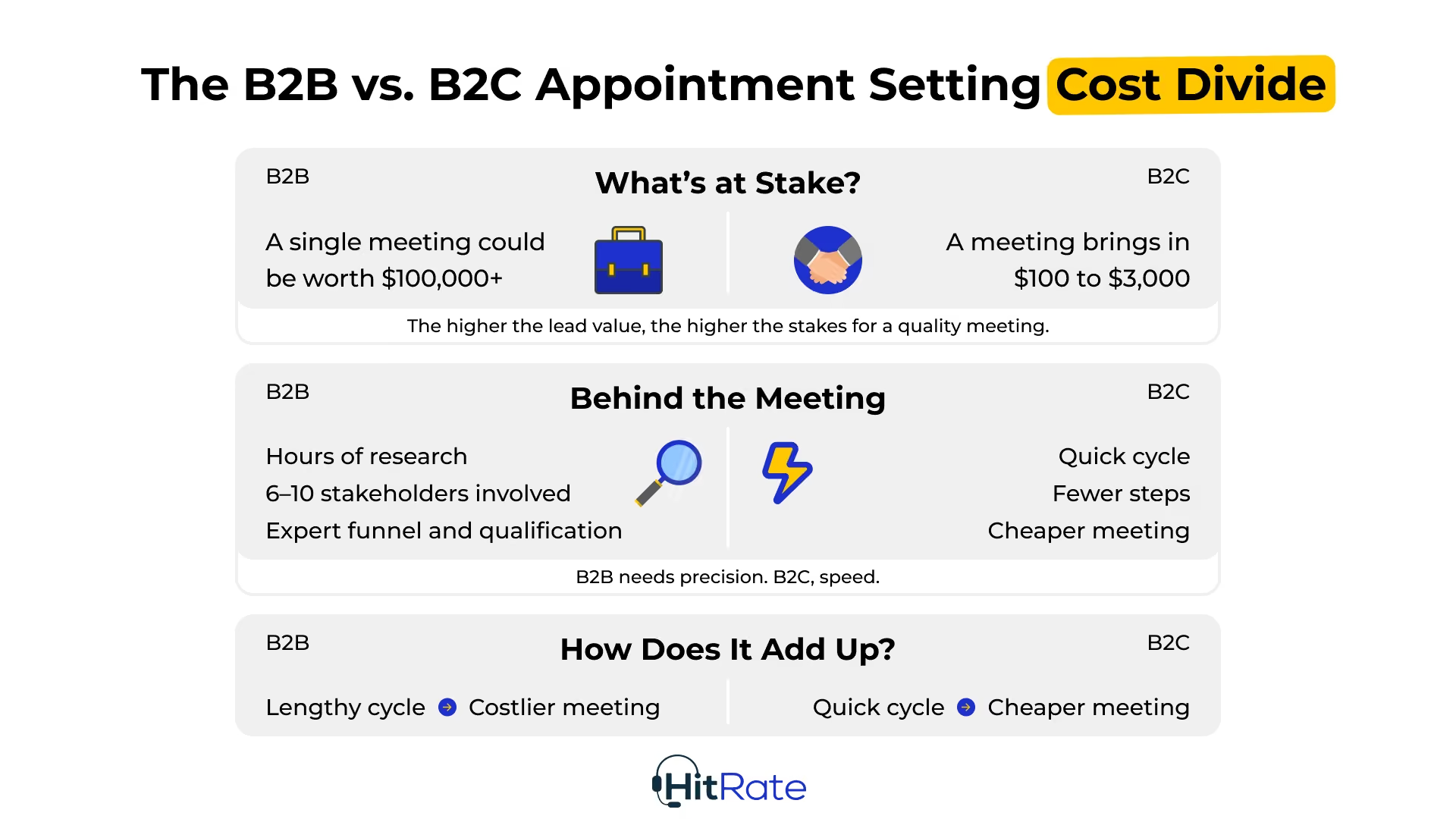
                        The B2B vs. B2C Appointment Setting Cost Divide

                        B2B retainers in 2026 typically run $2,000–$10,000+/month; B2C campaigns start closer to $500–$2,000/month for comparable volume. Longer sales cycles, senior contacts, and multi-step qualification push B2B rates up. The relationship between lead generation and appointment setting is tighter in B2B, where one unqualified meeting wastes more of your sales team's time.

                        Choosing the Right Pricing Model: Aligning Budget with Needs

                        Selecting the right price structure for appointment setting depends on how well you can define your campaign parameters upfront.

                        • Budget: Start by assessing your budgetary constraints. Retainer models offer predictable costs and are best when you want a dedicated team with consistent output; hourly rates make sense for shorter, lower-commitment campaigns.
                        • Appointment volume: Consider your anticipated volume of appointments. Retainer models become more cost-effective at scale, while pay-per-appointment structures are practical for testing a new market or vertical before committing to a larger program.
                        • Desired control: Assess your level of desired control over the appointment setting process and quality. Hourly rates offer greater control over time spent, for example.
                        • Sales cycle length: Businesses with shorter, higher-volume sales cycles β€” including B2C insurance and real estate outreach β€” often do well with hourly or pay-per-appointment structures. Longer B2B cycles favor retainer or hybrid models where the provider has time to fully understand your offer and target persona.

                        Make the Right Investment in Your Sales Pipeline

                        The right pricing model saves money β€” the right partner generates revenue. As a professional call center with over 15 years of experience in appointment setting and lead generation, Hit Rate Solutions balances cost efficiency with lead quality. We also offer cold calling services for businesses building a full outbound program. Contact us for transparent, competitive pricing tailored to your goals.

                        Unlock Qualified Meetings That Convert into Sales

                        Our expert appointment setters connect your closers with decision-makers who are ready to buy.

                        Contact UsContact Us for a Free Consultation
                        Background curve

                        Know What You Should Be Paying

                        Get a custom quote based on your industry, volume, and campaign goals β€” no guesswork.

                        Contact UsGet a Quote
                        Background curve