.svg)


A staggering 48% of sales reps give up after just one contact attempt, while 80% of deals require five or more touchpoints to close. This persistence gap costs businesses millions in lost revenue every year.
Our Philippines call center has perfected the follow-up process across insurance, real estate, and healthcare sectors to generate consistent results for US businesses. This guide reveals our strategic framework for writing cold follow-up emails after phone calls, scenario-based templates that convert, timing psychology backed by data, and automation strategies that scale without sacrificing personalization.
Why Your Follow-Up Emails Are Failing (And It's Costing You Deals)
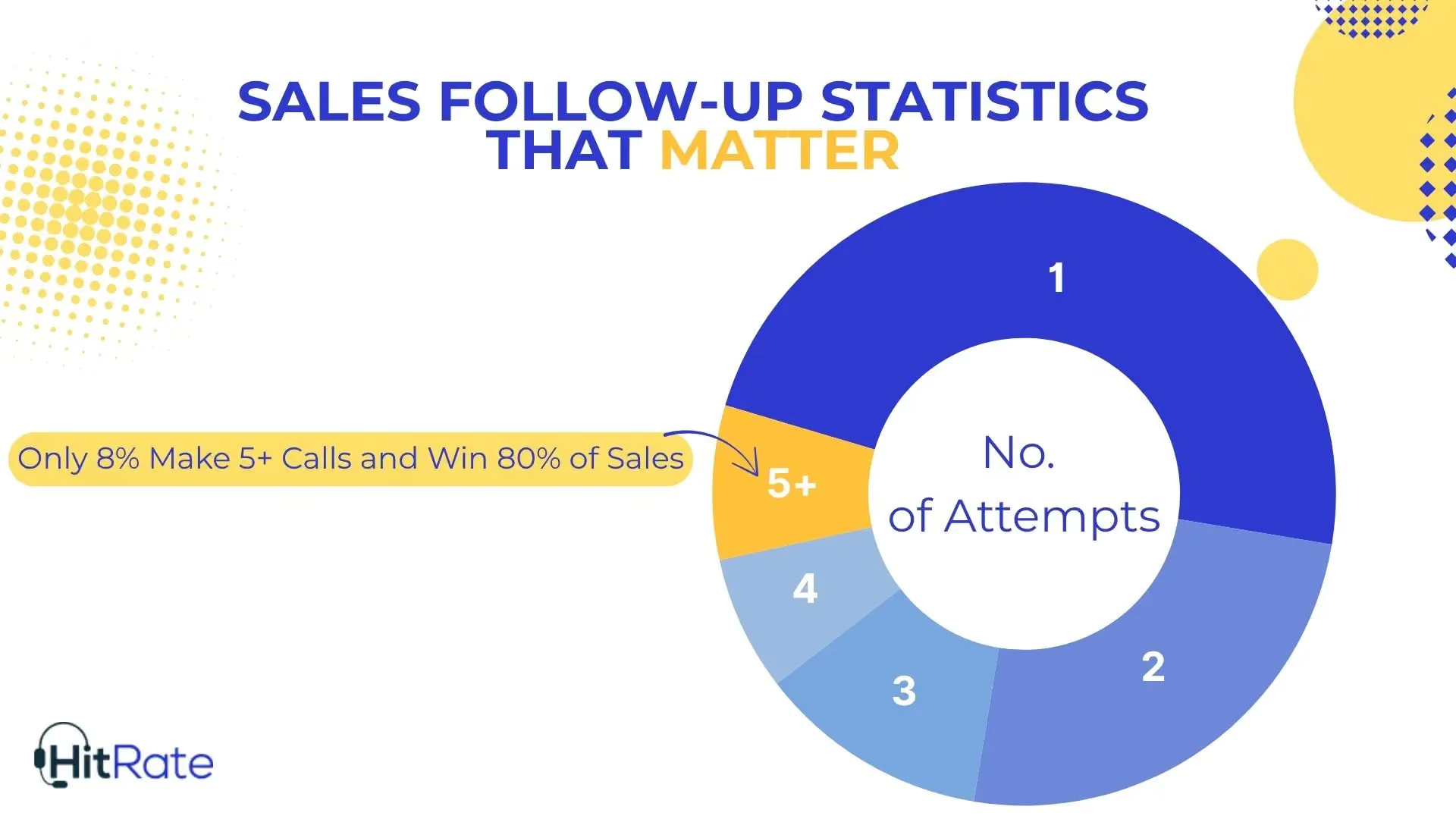
Before diving into cold email follow-up templates, founders need to diagnose the strategic failures happening in their sales process:
- Generic messaging that doesn't reference the actual conversation: Your follow-up emails fail when they don't mention specific call details.
- Poor timing (sending too early shows desperation, too late loses momentum): The sweet spot exists between appearing eager and losing interest. Within 24 hours yields a 25% reply rate, while waiting 72+ hours drops responses to just 8%.
- Weak CTAs that don't move deals forward: Vague requests like "let me know your thoughts" leave prospects confused about next steps. Clear, specific CTAs increase conversion rates by 38% compared to open-ended messages.
- Lack of personalization beyond name insertion: Simply adding {FirstName} isn't personalization. 73% of customers expect personalized experiences that demonstrate you actually listened during the call.
- Missing the prospect's actual pain points discussed on the call: When your follow-up doesn't address their different pain point, you waste everyone's time. The polite follow up email addresses pain points strategically, not aggressively pushing solutions.
These failures are completely fixable when you implement the right timing strategy and systematic approach.
The Science of Follow-Up Sequence and Timing
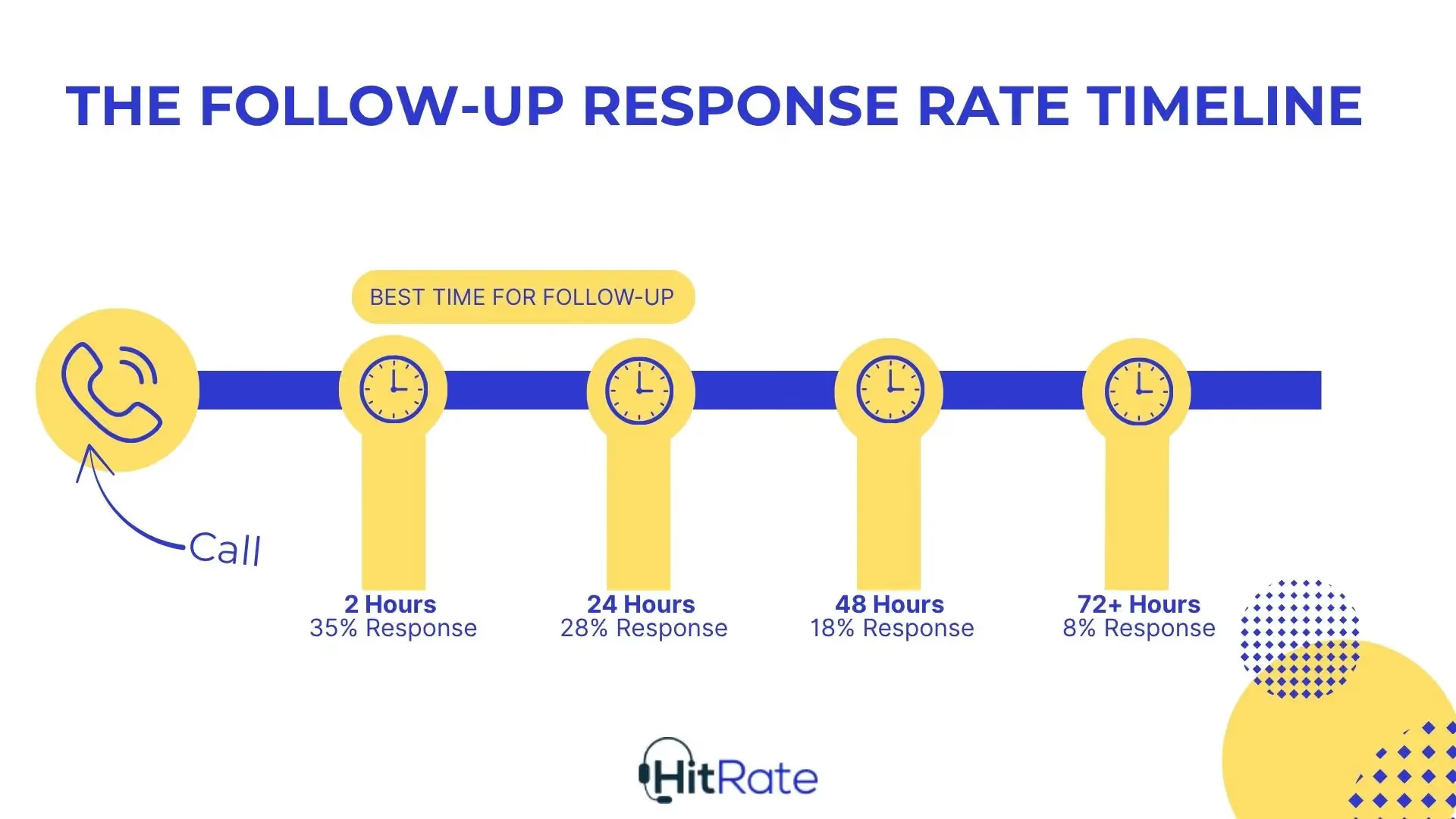
Timing your follow-up sequence isn't about following rigid rules but matching your approach to the prospect's decision-making process.
The Golden Window for Initial Contact
Send your first follow-up within 2-4 hours for hot leads who showed strong interest. This immediate value approach keeps the previous conversation fresh and shows professionalism. For discovery calls requiring more thought, the next-day follow-up performs better, giving prospects time to process while maintaining momentum.
Strategic Spacing for Subsequent Messages
After your initial email, send follow-ups strategically. Research shows that waiting 2-3 days between touches can increase reply rates by 11%. The optimal cadence follows this pattern: Day 1, Day 3, Day 7, then Day 14 for the final attempt.
The Thank You Question
Should you send a thank-you email after a phone call? Yes, but make it value-driven. A simple "thanks for your time" wastes an opportunity. Instead, thank them while providing additional resources or clarifying next steps.
Strategic timing sets the foundation, but without the right message, even perfectly timed emails fall flat.
5 Battle-Tested Follow-Up Templates for Every Sales Scenario
These aren't generic templates but proven frameworks refined across thousands of calls in insurance, real estate, and healthcare industries.
#1 After a Positive Discovery Call

Subject: [Company Name] — Next Steps for [Specific Solution Discussed]
Hi [Name],
Thanks for taking the time to discuss [specific pain point] earlier today. Your point about [specific challenge they mentioned] really resonated, especially considering the compliance changes in [their industry].
Based on what you shared about [their goal], I've attached a case study showing how we helped [similar company] achieve [specific result]. They faced the same [challenge] and saw [specific metric] improvement within [timeframe].
Would Thursday at 2 PM work for a 15-minute call to review the implementation roadmap?
Best, [Your name]
#2 After Meeting Objections
When prospects raise concerns, your follow-up needs to address them directly without being pushy. Focus on providing proof points and suggesting smaller commitments.
Subject: Addressing Your Question About [Specific Objection]
Hi [Name],
I've been thinking about your concern regarding [specific objection] from our call. It's a valid point that many [industry] companies raise.
Here's how [similar company] handled the same challenge: [brief solution]. They started with a smaller pilot program to test results before scaling. Would a similar approach work for your team?
I can share their full implementation plan if you're interested.
[Your name]
#3 After No Response (The Breakup Email)
Strategic re-engagement without desperation is crucial for how to write a follow-up email after no response to a meeting request.
Subject: Should I close your file?
Hi [Name],
I haven't heard back about [specific solution discussed] since our call on [date]. I realize priorities shift quickly in [their industry].
Should I assume you've gone in a different direction, or is this still worth exploring when timing is better?
Either way, I'll close your file for now but feel free to reach out if things change.
[Your name]

#4 After a Voicemail
Converting one-way communication into dialogue requires acknowledging the missed connection while providing value.
Subject: Tried Reaching You — Quick Question About [Topic]
Hi [Name],
Just left you a voicemail about [specific topic]. Rather than playing phone tag, I wanted to send over the [resource] we discussed regarding [their challenge].
[Link to resource]
What's the best way to connect this week? I'm available [two specific time slots] or happy to work around your schedule.
[Your name]
#5 The Professional Follow-Up Alternative
Instead of saying "just following up", use value-driven language that respects the prospect's time.
Subject: New Development in [Their Industry/Challenge]
Hi [Name],
Saw this [news/update/regulation] about [their industry] and remembered our conversation about [specific challenge].
[Brief insight or link]
Still interested in discussing how this might impact your [specific business area]?
[Your name]
Templates provide structure, but personalization transforms them into conversion machines.
Building Your Follow-Up Machine: From Manual to Automated
As a founder, your goal is to remove yourself from daily follow-up management while maintaining quality that converts.
Creating Team Playbooks
Document your follow-up process with clear templates for each scenario. Include subject line formulas, personalization guidelines, and CTA options that sales teams can execute consistently.
CRM Integration Essentials
Connect your follow-up sequence to HubSpot, Apollo, or Salesforce for automatic follow-ups. Set triggers based on call outcomes so no prospect falls through the cracks. Our teams manage 500+ daily follow-ups while maintaining 35% response rates using these exact systems.
AI-Powered Draft Generation
Use AI to generate initial drafts but always add human review for authenticity. The best prompts reference specific call notes and pain points to create personalized messages at scale.
Quality Control Checkpoints
Review random samples weekly to track which sales professionals consistently get responses. Identify patterns in successful emails versus those that fail to drive continuous improvement.

When to Consider Outsourcing
Professional call center services make sense when your team sends 100+ follow-ups daily. HitRate Solutions' outbound services start at just $7.50 per hour for 160 hours monthly, including CRM integration and daily reporting with a typical 25x ROI through improved conversions. Building the machine is just the start. Measuring performance drives continuous improvement.
Measuring What Matters: Follow-Up Metrics That Drive Revenue
You can't improve what you don't measure, especially when managing complex sales follow-up emails across multiple team members.
- Response rates by template type: Track which templates generate responses consistently. Our data shows breakup emails achieve 33% response rates while standard follow-ups hover around 21%, helping you adjust your approach based on what works.
- Time-to-response tracking: Monitor how quickly prospects reply to different email types. Urgent, time-sensitive messages typically see responses within 4 hours while educational content might take 24-48 hours.
- Conversion rates from follow-up to next step: Measure progression from initial email through to closed deal. Average email conversion rates range from 2-5%, but optimized sequences can reach 8-10% when tracking each stage.
- Revenue attribution to follow-up sequences: Calculate revenue generated from strategic follow-ups versus single-touch attempts. Companies using multiple touchpoints see 70% higher conversion rates than those sending just one email.
- Team performance variations: Identify which sales reps consistently outperform others to replicate their success. This data reveals training opportunities and best practices worth scaling.
- Cost per qualified response: Healthcare services average 23.7% open rates with 3.0% CTR, real estate sees 21.7% opens with 3.6% CTR, while IT lags at 22.7% opens but only 2.0% CTR.
The compound effect of optimized follow-ups transforms your entire sales process from reactive to predictable revenue generation.
Transform Your Follow-Up Process into a Revenue Machine
Follow-up success requires strategic timing between 2-24 hours post-call, scenario-specific templates that reference actual conversation points, and systematic personalization beyond basic mail merge. The difference between companies converting at 35% versus 10% isn't talent but having a proven follow-up system that scales from founder-led sales to full team execution.
HitRate Solutions' call center has perfected follow-up communication across eight major industries. Our appointment setting and lead generation teams don't just send emails but build relationships that convert prospects into revenue. Contact us today to transform your follow-up process from a weakness into your competitive advantage.